


 compliance team
If you've received a notification from Amazon or another marketplace asking for a Spanish EPR registration number, review the request and the stated deadline in your marketplace account. This article explains the possible registration route. For the wider context, see our EPR in Spain guide. eprspain.com is an independent private service and is not affiliated with Amazon.
When Amazon asks for a número de registro de envases, it is asking for the registration number issued by the packaging section of Spain's Registro de Productores de Producto (RPP). For 2026 registrations, the format is:
ENV/2026/XXXXXXXXX
The final block contains nine digits. The year changes with the year of registration.
Review the Spain packaging EPR request in Seller Central.
Diagnose
Confirm the category and legal entity Amazon is checking
File
Complete NIF, representative, scheme and RPP steps
Upload
Submit the ENV number with final evidence
Maintain
Keep declarations and scheme membership active
| Identifier | Use in Amazon packaging EPR |
|---|---|
| ENV/YEAR/9 digits | Yes: this is the producer-register number |
| NIF / VAT / EORI | No: these identify tax or customs status |
| Scheme reference | Supporting evidence, but not the ENV number |
Why marketplaces are asking
Spanish rules can create obligations for producers and for platforms that enable their sales. A marketplace may therefore request and review producer-registration information, and may restrict listings under its own policies. The platform independently decides what information satisfies its request.
What this number proves
The ENV number identifies the producer in Spain's national packaging register. During the filing, the producer declares its packaging categories and responsibility system, and supplies evidence of participation in the relevant individual or collective scheme.
It is public registration data. It is also the number that must appear on invoices and other commercial documents accompanying transactions for covered packaged products under Spain's national rules.
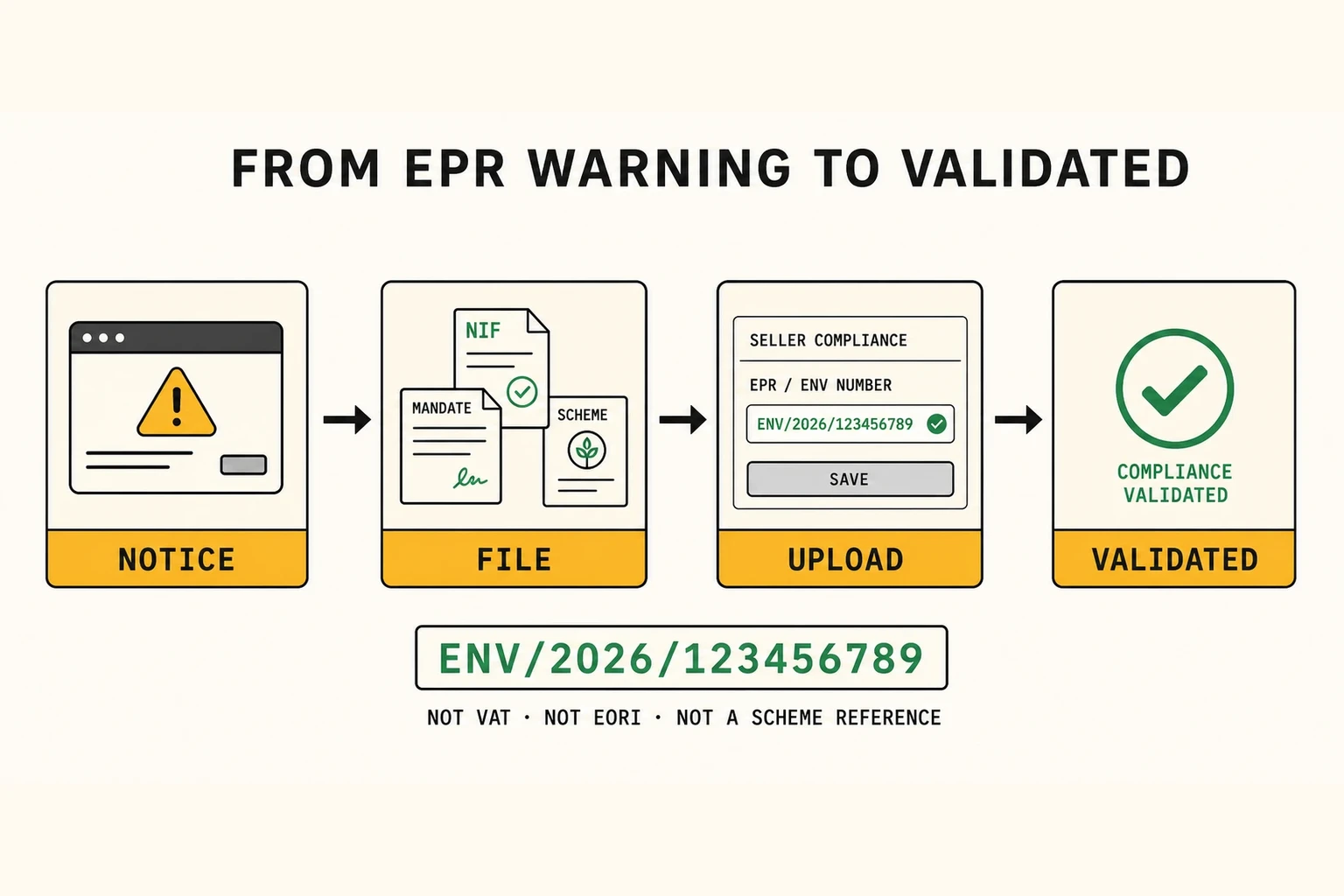
Numbers that Amazon does not mean
| Identifier | Purpose | Use as packaging ERN? |
|---|---|---|
| ENV/2026/XXXXXXXXX | Spanish packaging producer register | Yes |
| Spanish NIF | Tax/administrative identity in Spain | No |
| EU VAT number | VAT reporting and validation | No |
| EORI | Customs identity | No |
| Ecoembes or scheme reference | Scheme membership | No |
| REGAGE application code | Electronic filing receipt | No |
MITECO specifically warns applicants not to confuse the ENV number with the REGAGE code on the filing receipt. The ENV number only becomes definitive when all registration steps have been completed and the filing has been signed.
How to obtain the ENV number
- Confirm producer status. Identify the legal entity first placing the packaged goods on the Spanish market.
- Appoint a representative. Non-resident producers use a Spain-established authorised representative for the packaging obligations.
- Prepare identification. This typically includes corporate documents, signatory authority and a Spanish NIF.
- Join a responsibility scheme. Registration asks for the relevant scheme and membership evidence.
- File in the RPP. Complete and sign the electronic procedure, then retain the final proof with the ENV number.
Each step is detailed in our step-by-step guide to the packaging register, and the RPP registration documents checklist lists the documents to gather first.
Timing depends on document completeness and independent processing by the tax agency, representative, producer registry and scheme. If the marketplace requests an update while an application is pending, we can prepare factual evidence of the current status. Amazon independently decides whether to accept that evidence or restrict a listing; issuance, timing and marketplace acceptance are not guaranteed.
Where to submit it in Amazon
In Seller Central, the number goes in your account's compliance section for Spain. Submit it only once the number and the packaging category are correct, and keep the registration certificate with it: a platform may ask for the underlying document. Submitted does not mean accepted, as Amazon reviews each submission independently.
Why the number matters more under PPWR
Since 12 August 2026, PPWR Article 45 has told covered marketplaces to obtain producer registration information for the Member State where the consumer is located. That pushes the national ENV number from a registry form into routine platform verification.
Does Pay on Behalf issue the number?
No. Amazon says Pay on Behalf is used when a seller has not submitted a valid EPR Registration Number. It can calculate and pay eco-contributions on covered Amazon sales, but it does not, by itself, put your legal entity into MITECO's register.
See Pay on Behalf vs own registration for the cost and coverage comparison.
What comes after registration?
Keep the ENV number on the required commercial documentation, maintain active responsibility-scheme participation, collect packaging weights by material and submit the annual declaration. Registration is the start of a managed compliance record, not a one-time badge.
For the complete Amazon picture, from the producer test to the PPWR marketplace check, see our EPR guide for Amazon sellers in Spain.
The short version
- Amazon independently reviews every submission
- The number comes from the Spanish producers' registry — via a NIF, a representative, and a registration.
- Processing time varies; a marketplace independently decides how it treats evidence of an application in progress.
- Ongoing declarations may be part of the scope — see pricing for the private services and separate scheme charges.
Final thoughts
Authority- or scheme-issued records A producer-registry record is only one part of the possible EPR scope. Responsibility-scheme membership and annual declarations may also apply. A marketplace independently reviews the information submitted to it, and neither a registry application nor a declaration guarantees a listing outcome.
Amazon independently reviews every submission A producer registration is not issued separately for each sales channel. However, each marketplace independently determines what information it requests and accepts. Additional product streams such as WEEE or batteries can require separate registrations.
External bodies make their own decisions and issue their own records Processing time varies; a marketplace independently decides how it treats evidence of an application in progress.