


 compliance team
Regulation (EU) 2025/40 on packaging and packaging waste—PPWR—has applied since 12 August 2026. For cross-border sellers, the headline issue is not a new recycling label. It is the connection between a local EPR representative, national producer registration and marketplace verification.
The PPWR page for Spain sums up what changed for sellers shipping to Spain. This article explains the legal mechanics behind it.
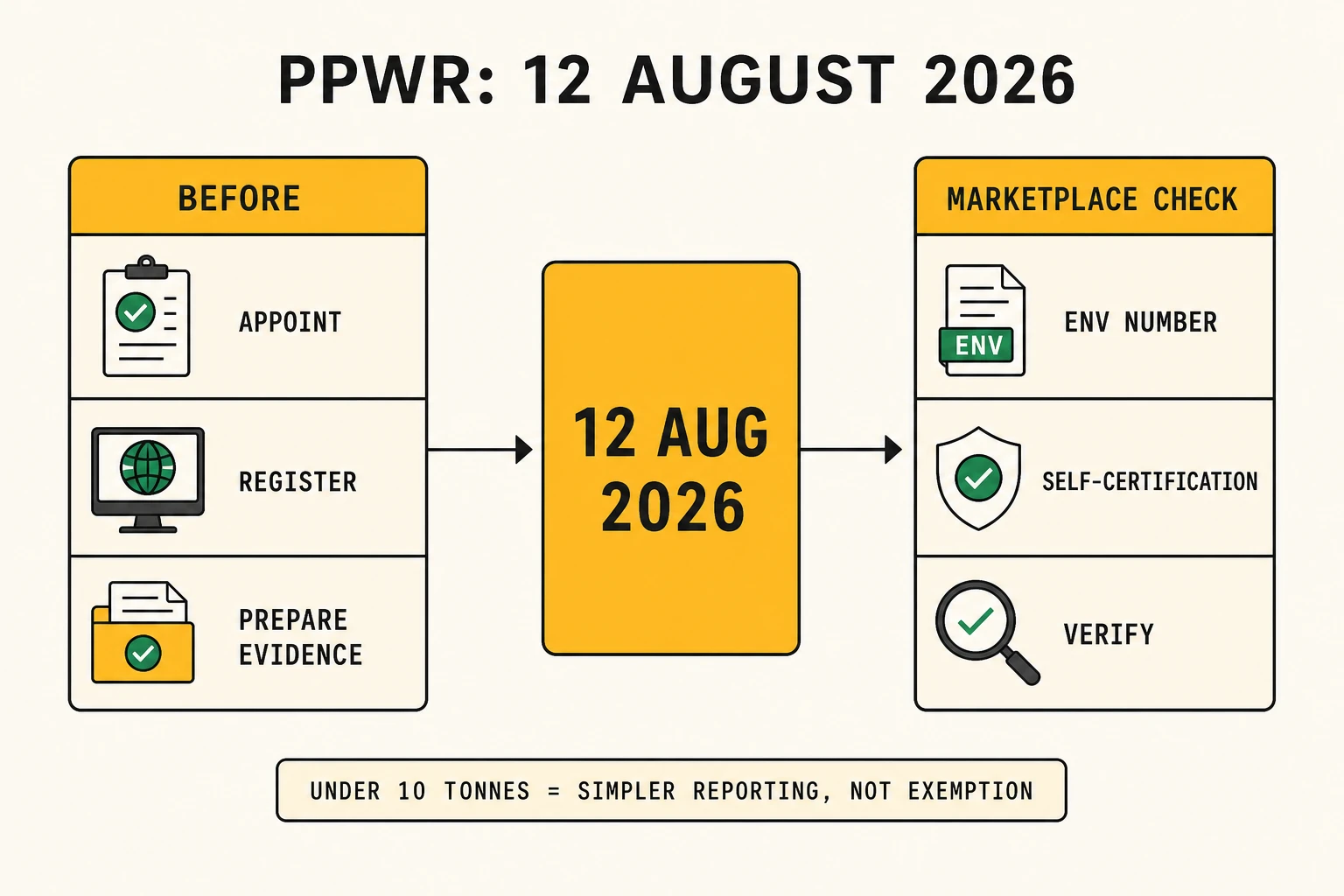
The evidence chain PPWR makes commercially visible
Mandate
Appoint the correct EPR representative in Spain
Register
Obtain the national packaging registration
Certify
Prepare the producer self-certification
Verify
Give the marketplace a complete evidence pack
| PPWR point | Operational consequence |
|---|---|
| Article 44 | Registration is national and precedes market access |
| Article 45 | Representation and marketplace information become linked |
| Under 10 tonnes | Simpler reporting, not a registration exemption |
What Article 44 requires
Article 44 requires a producer to register in every Member State where it first makes packaging or packaged products available, or where it unpacks packaged products without being the end user. It also states that producers must not make covered packaging available in a Member State if they—or the relevant representative—are not registered there.
This is a national system, not one EU-wide licence. A Spanish registration covers Spain; it is not a passport for Germany, France or Italy.
What Article 45 requires
Article 45 assigns extended producer responsibility and addresses the representative. Under the adopted text, a producer making distance sales directly into another Member State appoints an authorised representative for EPR there by written mandate.
The representative is not merely a mail-forwarding address. It is the locally established person mandated to fulfil the producer's Chapter VIII EPR obligations, including registration and the national compliance trail.
Non-EU sellers should act first
A third-country seller can fall within the PPWR producer definition when it makes packaged products available directly to EU end users. National law then matters alongside PPWR. Spain already requires a producer established in another state to appoint an authorised representative for packaging obligations; without one, Spanish rules can shift responsibility to the first Spain-based distributor or, in defined marketplace situations, the platform.
That is why 12 August 2026 was not the starting point for US, UK, Swiss and Chinese sellers into Spain. The Spanish registration steps already existed, and a seller still missing them is behind on both sets of rules.
Our PPWR checklist for non-EU sellers turns these steps into a filing plan for sellers outside the EU.
What about EU-established cross-border sellers?
There has been genuine legislative movement here. In December 2025, the European Commission proposed suspending PPWR Article 45(3) until 2035 for producers established in the EU, while preserving the framework for third-country producers. On 21 October 2026, the Council agreed a narrower negotiating mandate: an EU-established producer would not need an EPR representative in a Member State where it makes less than 1 tonne of packaging available a year, until 1 January 2032, and a national authority could still order an appointment after a breach of EPR obligations.
As of this article's 31 October 2026 review, that text still has to be agreed with the European Parliament, and it does not cover producers established outside the EU. Article 45(3) applies as adopted: businesses should work from the law in force and follow the negotiations rather than plan around an unadopted suspension.
Why marketplaces care
PPWR tells covered online platforms to obtain, before onboarding a producer:
- the producer's registration information and national number for the country where the customer is located; and
- a self-certification confirming that the offered packaging complies with the applicable EPR duties.
This makes the number commercially important. A platform does not need to wait for an environmental inspection to restrict a seller that cannot supply verifiable registration information.
Below 10 tonnes is simpler, not exempt
PPWR gives producers placing less than 10 tonnes of packaging on a national market a simplified annual reporting dataset. The text does not convert that threshold into an exemption from registration. Small parcel volumes can reduce the data burden and eco-contributions, but not eliminate the producer's identity in the register.
What to have in place now
- Determine the producer for every sales flow into Spain.
- Appoint a Spain-established EPR representative under a written mandate.
- Obtain the identifiers and authority documents needed for filing.
- Join an approved producer responsibility scheme.
- Complete the Spanish packaging-register filing and retain the final evidence.
- Give marketplaces the ENV number and reconcile packaging weights across all channels.
Do not confuse two authorised representatives
PPWR also uses the term “authorised representative” for product-conformity tasks that a manufacturer may delegate under Article 17. The EPR representative discussed here is separately defined and tied to Chapter VIII producer-responsibility duties. A product-safety representative is not automatically your EPR representative unless the mandate and legal requirements cover both roles.
The practical target is straightforward: at any time, be able to show who represents the producer in Spain, where the producer is registered, which scheme covers its packaging and how the reported material data is maintained.
Final thoughts
PPWR makes the evidence chain visible. A marketplace can ask who represents the producer, where it is registered and which national number applies.
Below 10 tonnes means simpler reporting, not no registration. Small sellers still need a valid producer identity and the applicable national coverage.
Prepare before the platform asks. Mandate, scheme certificate, ENV evidence and reconciled packaging data should already form one reviewable file.